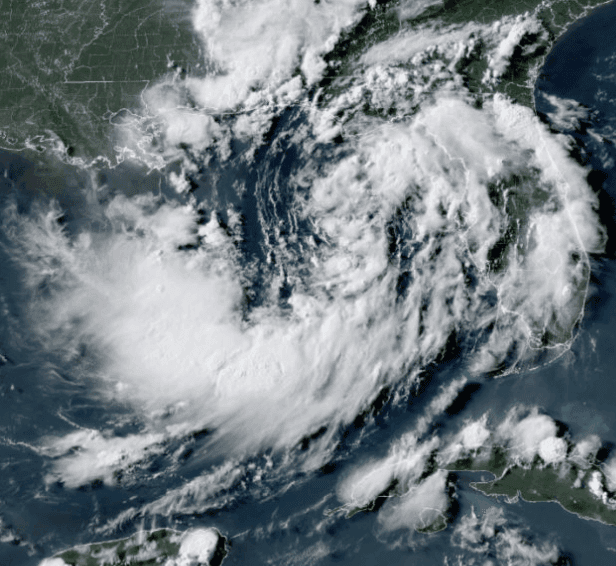
**Trader sentiment for the 2026 Atlantic hurricane season number-of-hurricanes market centers on a below-normal outlook driven by a developing El Niño and the season’s slow start.** As of mid-August, only three named storms (Arthur, Bertha, and Cristobal) have formed—all tropical storms with no hurricanes yet—well below the historical pace. NOAA’s August 6 update forecasts 2–6 hurricanes for the full June–November season (with a 75% chance of below-normal activity overall), citing persistent El Niño conditions that enhance vertical wind shear across the Atlantic main development region, disrupting tropical cyclone organization and intensification. Colorado State University and other models similarly point to roughly four hurricanes, aligning with the market’s narrow lead for the 4–6 bin at 45% implied probability versus 36% for 1–3. While the climatological peak (late August through early October) remains ahead and model runs can shift, the current atmospheric setup—stronger trade winds, drier mid-level air, and reduced sea-surface temperature anomalies favoring development—makes rapid catch-up to above-average totals less likely. Traders are pricing the scientific consensus on El Niño suppression more heavily than upside surprises from any late-season relaxation of shear.
Résumé expérimental généré par IA à partir des données Polymarket. Ceci n'est pas un conseil de trading et ne joue aucun rôle dans la résolution de ce marché. · Mis à jourCombien d'ouragans se formeront pendant la saison des ouragans de l'Atlantique en 2026 ?
Combien d'ouragans se formeront pendant la saison des ouragans de l'Atlantique en 2026 ?
4-6 46%
1-3 39%
7+ 11%
0 7%
0
7%
1-3
39%
4-6
43%
7+
14%
4-6 46%
1-3 39%
7+ 11%
0 7%
0
7%
1-3
39%
4-6
43%
7+
14%
If there is no storm categorized as a hurricane in the Atlantic during the specified timeframe this market will resolve to "0".
A hurricane is a tropical cyclone with maximum sustained winds of 74 mph or greater (Category 1 or higher on the Saffir-Simpson Hurricane Wind Scale), as described at https://www.nhc.noaa.gov/aboutsshws.php.
This market may resolve based on the initial NHC advisory reporting a qualifying hurricane regardless of any later advisory, retraction, best-track revision, or reanalysis that revises that storm's intensity downward. The official count will be determined by the NHC (nhc.noaa.gov) advisories.
Marché ouvert : Jul 28, 2026, 4:49 PM ET
Resolver
0x69c47De9D...If there is no storm categorized as a hurricane in the Atlantic during the specified timeframe this market will resolve to "0".
A hurricane is a tropical cyclone with maximum sustained winds of 74 mph or greater (Category 1 or higher on the Saffir-Simpson Hurricane Wind Scale), as described at https://www.nhc.noaa.gov/aboutsshws.php.
This market may resolve based on the initial NHC advisory reporting a qualifying hurricane regardless of any later advisory, retraction, best-track revision, or reanalysis that revises that storm's intensity downward. The official count will be determined by the NHC (nhc.noaa.gov) advisories.
Resolver
0x69c47De9D...**Trader sentiment for the 2026 Atlantic hurricane season number-of-hurricanes market centers on a below-normal outlook driven by a developing El Niño and the season’s slow start.** As of mid-August, only three named storms (Arthur, Bertha, and Cristobal) have formed—all tropical storms with no hurricanes yet—well below the historical pace. NOAA’s August 6 update forecasts 2–6 hurricanes for the full June–November season (with a 75% chance of below-normal activity overall), citing persistent El Niño conditions that enhance vertical wind shear across the Atlantic main development region, disrupting tropical cyclone organization and intensification. Colorado State University and other models similarly point to roughly four hurricanes, aligning with the market’s narrow lead for the 4–6 bin at 45% implied probability versus 36% for 1–3. While the climatological peak (late August through early October) remains ahead and model runs can shift, the current atmospheric setup—stronger trade winds, drier mid-level air, and reduced sea-surface temperature anomalies favoring development—makes rapid catch-up to above-average totals less likely. Traders are pricing the scientific consensus on El Niño suppression more heavily than upside surprises from any late-season relaxation of shear.
Résumé expérimental généré par IA à partir des données Polymarket. Ceci n'est pas un conseil de trading et ne joue aucun rôle dans la résolution de ce marché. · Mis à jour

Méfiez-vous des liens externes.
Méfiez-vous des liens externes.
Questions fréquentes