
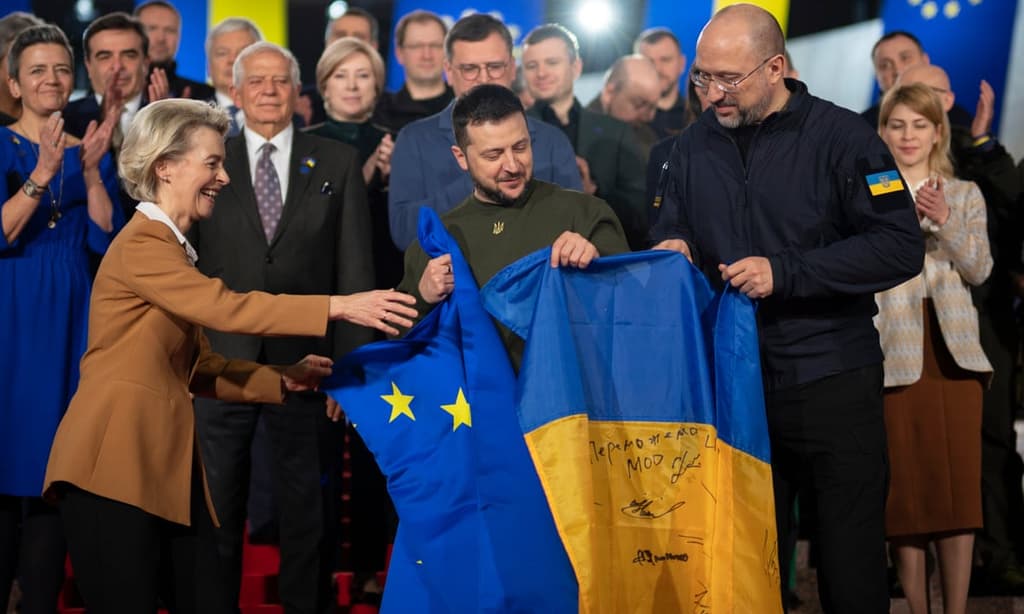
Recent developments center on European Commission President Ursula von der Leyen’s September 16, 2026, proposal for Canada to become the EU’s first “associate member,” a status without current treaty definition. Canadian Prime Minister Mark Carney welcomed deeper cooperation on defense, critical minerals, energy security, AI, and trade but explicitly stated Ottawa seeks a “unique alliance” short of full membership and has no plans to apply. EU treaties limit membership to European states, creating a structural barrier. An EU-Canada summit scheduled for late October in Montreal offers the next opportunity to define any enhanced partnership, building on the existing CETA framework amid shifting transatlantic trade dynamics. These statements and procedural realities shape expectations around formal accession steps.
基于Polymarket数据的AI实验性摘要。这不是交易建议,也不影响该市场的结算方式。 · 更新于2026年12月31日
2%
2027年12月31日
9%
$1,254 交易量
2026年12月31日
2%
2027年12月31日
9%
A formal application means a written request for Canada to become a member state of the European Union The application must be submitted by the Government of Canada or by a representative acting with its authority.
An application will qualify even if it seeks or anticipates opt-outs, exemptions, or transition periods on specific European Union policies. A request, proposal, negotiation, or agreement concerning associate membership, an "Alliance for the Future" or other partnership, an association agreement, a framework agreement, membership in the European Economic Area, a customs union, or any other status short of membership will not qualify. Statements of intent, expressions of interest, exploratory talks, parliamentary motions, petitions, and proposals or invitations from the European Union or any of its member states will not qualify.
Once a qualifying application has been submitted, this market will resolve to "Yes" regardless of whether the European Union accepts, rejects, deems inadmissible, or acts on the application, and whether the application is later withdrawn.
The primary resolution sources for this market will be official information from the Government of Canada, the Council of the European Union, the European Council, and the European Commission; however, a consensus of credible reporting may also be used.
市场开放时间: Sep 17, 2026, 1:11 PM ET
A formal application means a written request for Canada to become a member state of the European Union The application must be submitted by the Government of Canada or by a representative acting with its authority.
An application will qualify even if it seeks or anticipates opt-outs, exemptions, or transition periods on specific European Union policies. A request, proposal, negotiation, or agreement concerning associate membership, an "Alliance for the Future" or other partnership, an association agreement, a framework agreement, membership in the European Economic Area, a customs union, or any other status short of membership will not qualify. Statements of intent, expressions of interest, exploratory talks, parliamentary motions, petitions, and proposals or invitations from the European Union or any of its member states will not qualify.
Once a qualifying application has been submitted, this market will resolve to "Yes" regardless of whether the European Union accepts, rejects, deems inadmissible, or acts on the application, and whether the application is later withdrawn.
The primary resolution sources for this market will be official information from the Government of Canada, the Council of the European Union, the European Council, and the European Commission; however, a consensus of credible reporting may also be used.
Recent developments center on European Commission President Ursula von der Leyen’s September 16, 2026, proposal for Canada to become the EU’s first “associate member,” a status without current treaty definition. Canadian Prime Minister Mark Carney welcomed deeper cooperation on defense, critical minerals, energy security, AI, and trade but explicitly stated Ottawa seeks a “unique alliance” short of full membership and has no plans to apply. EU treaties limit membership to European states, creating a structural barrier. An EU-Canada summit scheduled for late October in Montreal offers the next opportunity to define any enhanced partnership, building on the existing CETA framework amid shifting transatlantic trade dynamics. These statements and procedural realities shape expectations around formal accession steps.
基于Polymarket数据的AI实验性摘要。这不是交易建议,也不影响该市场的结算方式。 · 更新于
警惕外部链接哦。
警惕外部链接哦。
常见问题