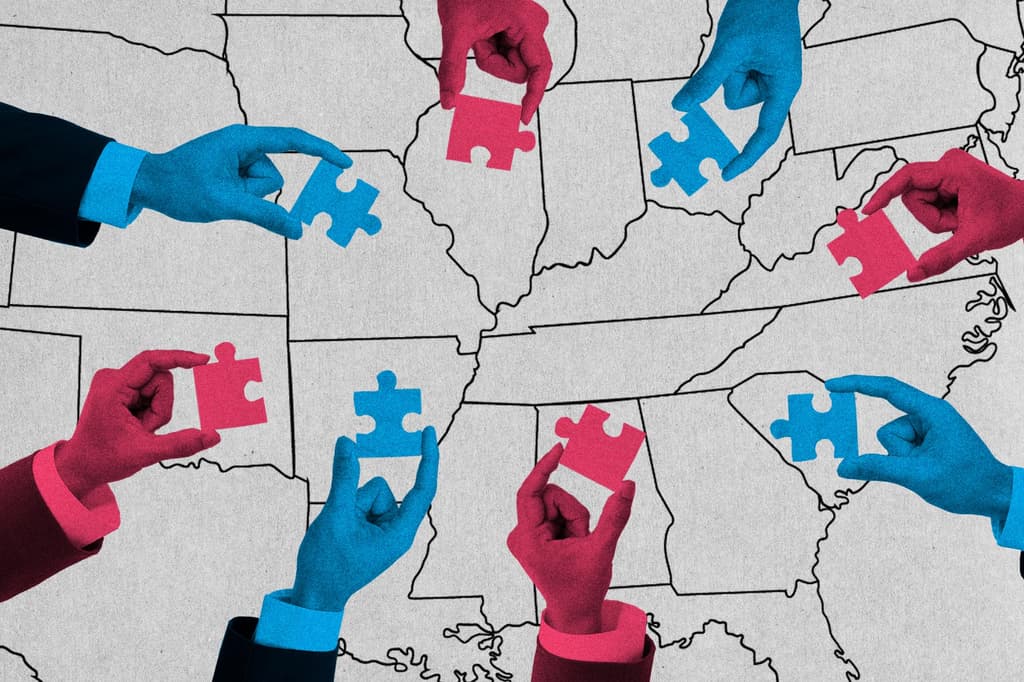
Several states have pursued mid-decade congressional redistricting ahead of the 2026 House elections, with ten—Alabama, California, Florida, Louisiana, Missouri, North Carolina, Ohio, Tennessee, Texas, and Utah—enacting revised maps following legislative sessions, ballot measures, and court proceedings. A May 2026 Supreme Court ruling in Louisiana v. Callais shifted standards for Voting Rights Act challenges, enabling some states to implement or restore maps previously blocked on racial gerrymandering grounds. Partisan legislative majorities drove most changes, with Republican-led efforts in the South and Texas aiming to adjust district lines before candidate filing deadlines and primaries. Ongoing litigation in a few states and adjusted election calendars continue to shape which maps reach voters in November 2026.
Resumen experimental generado por IA con datos de Polymarket. Esto no es asesoramiento de trading y no influye en cómo se resuelve este mercado. · ActualizadoWhich states will use new congressional maps in the midterms?
Which states will use new congressional maps in the midterms?
$395,140 Vol.
California
97%
Texas
98%
North Carolina
96%
Ohio
94%
Utah
91%
Florida
98%
Louisiana
93%
Missouri
93%
Virginia
5%
Alabama
91%
South Carolina
<1%
Georgia
6%
Kansas
<1%
New Jersey
4%
Indiana
5%
Washington
3%
Nebraska
4%
Illinois
2%
Minnesota
5%
New York
4%
Maryland
4%
Wisconsin
3%
$395,140 Vol.
California
97%
Texas
98%
North Carolina
96%
Ohio
94%
Utah
91%
Florida
98%
Louisiana
93%
Missouri
93%
Virginia
5%
Alabama
91%
South Carolina
<1%
Georgia
6%
Kansas
<1%
New Jersey
4%
Indiana
5%
Washington
3%
Nebraska
4%
Illinois
2%
Minnesota
5%
New York
4%
Maryland
4%
Wisconsin
3%
To qualify, after the 2024 United States congressional elections, the listed state must have adopted a new congressional district map that is:
- Formally adopted and enacted into law by the appropriate legislative or redistricting authority;
- Not enjoined, vacated or otherwise fully struck down prior to the 2026 United States Midterm elections; and
- In effect for use in the 2026 United States midterm elections.
Maps that are temporarily stayed pending appeal but later upheld will qualify if they are in effect for use in the 2026 United States midterm elections.
Maps that are completely redrawn by a court, special master, or legislature before implementation will not qualify, unless the redrawn map is itself a new map used in the 2026 United States midterm elections.
If the 2026 United States midterm elections occur and no new qualifying map is in use, this market will resolve to “No”.
The primary resolution sources for this market will be official information from the listed state and a consensus of credible reporting.
Mercado abierto: Apr 30, 2026, 2:25 PM ET
Resolver
0x65070BE91...To qualify, after the 2024 United States congressional elections, the listed state must have adopted a new congressional district map that is:
- Formally adopted and enacted into law by the appropriate legislative or redistricting authority;
- Not enjoined, vacated or otherwise fully struck down prior to the 2026 United States Midterm elections; and
- In effect for use in the 2026 United States midterm elections.
Maps that are temporarily stayed pending appeal but later upheld will qualify if they are in effect for use in the 2026 United States midterm elections.
Maps that are completely redrawn by a court, special master, or legislature before implementation will not qualify, unless the redrawn map is itself a new map used in the 2026 United States midterm elections.
If the 2026 United States midterm elections occur and no new qualifying map is in use, this market will resolve to “No”.
The primary resolution sources for this market will be official information from the listed state and a consensus of credible reporting.
Resolver
0x65070BE91...Several states have pursued mid-decade congressional redistricting ahead of the 2026 House elections, with ten—Alabama, California, Florida, Louisiana, Missouri, North Carolina, Ohio, Tennessee, Texas, and Utah—enacting revised maps following legislative sessions, ballot measures, and court proceedings. A May 2026 Supreme Court ruling in Louisiana v. Callais shifted standards for Voting Rights Act challenges, enabling some states to implement or restore maps previously blocked on racial gerrymandering grounds. Partisan legislative majorities drove most changes, with Republican-led efforts in the South and Texas aiming to adjust district lines before candidate filing deadlines and primaries. Ongoing litigation in a few states and adjusted election calendars continue to shape which maps reach voters in November 2026.
Resumen experimental generado por IA con datos de Polymarket. Esto no es asesoramiento de trading y no influye en cómo se resuelve este mercado. · ActualizadoRelacionado

¿Se celebrarán las elecciones de mitad de período de 2026 según lo programado?

¿No ganarán los titulares demócratas de la Cámara entre diez y doce elecciones de nominación en el ciclo de 2026?

¿Habrá entre 120 millones y 125 millones de votos emitidos en las elecciones de mitad de período de la Cámara de Representantes de EE. UU. en 2026?
Cuidado con los enlaces externos.
Cuidado con los enlaces externos.
Preguntas frecuentes