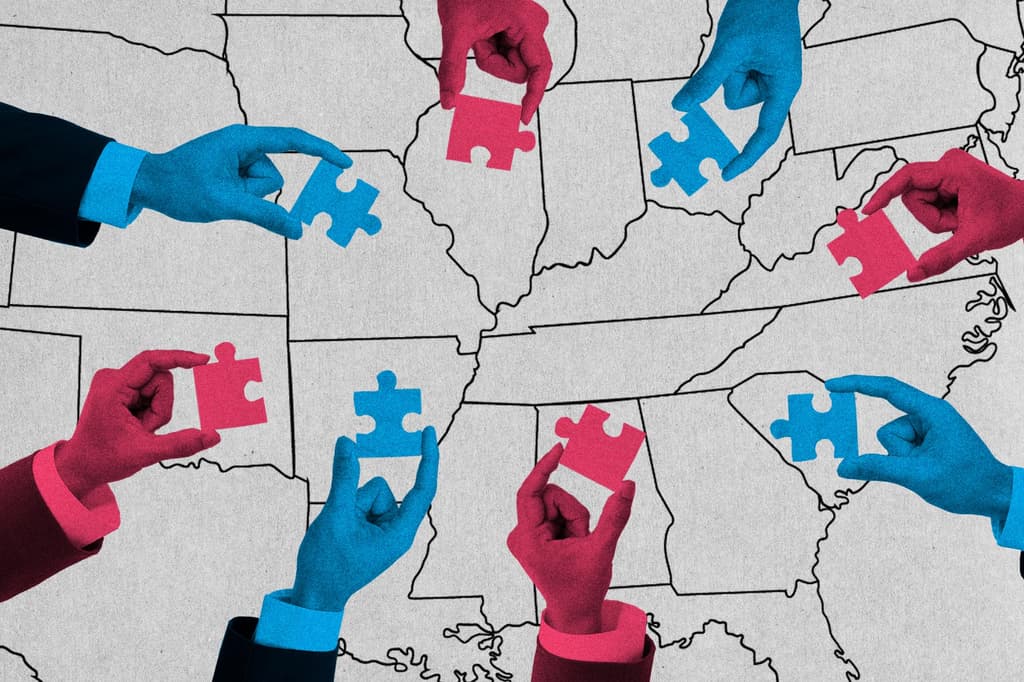
Ten states—Alabama, California, Florida, Louisiana, Missouri, North Carolina, Ohio, Tennessee, Texas, and Utah—have enacted new congressional maps since mid-2025 through legislative action, special sessions, or court orders, marking the largest wave of mid-decade redistricting in over a century. Key drivers include the Supreme Court’s May 2026 ruling in Louisiana v. Callais, which altered Voting Rights Act standards and prompted map revisions in multiple Southern states, along with partisan efforts to adjust district lines before the November 2026 House elections. Ongoing litigation in several states, including challenges to racial or partisan gerrymandering claims, continues to shape final boundaries, while special primaries and ballot measures in places like Virginia and Utah add further uncertainty. These developments directly influence which maps election officials will administer.
Експериментальне резюме, згенероване ШІ з посиланням на дані Polymarket. Це не торгова порада і не впливає на вирішення цього ринку. · ОновленоWhich states will use new congressional maps in the midterms?
$395,136 Обс.
California
98%
Texas
98%
North Carolina
96%
Ohio
96%
Utah
91%
Florida
98%
Louisiana
93%
Missouri
93%
Virginia
5%
Alabama
91%
South Carolina
<1%
Georgia
6%
Kansas
<1%
New Jersey
4%
Indiana
5%
Washington
4%
Nebraska
5%
Illinois
2%
Minnesota
5%
New York
3%
Maryland
4%
Wisconsin
2%
$395,136 Обс.
California
98%
Texas
98%
North Carolina
96%
Ohio
96%
Utah
91%
Florida
98%
Louisiana
93%
Missouri
93%
Virginia
5%
Alabama
91%
South Carolina
<1%
Georgia
6%
Kansas
<1%
New Jersey
4%
Indiana
5%
Washington
4%
Nebraska
5%
Illinois
2%
Minnesota
5%
New York
3%
Maryland
4%
Wisconsin
2%
To qualify, after the 2024 United States congressional elections, the listed state must have adopted a new congressional district map that is:
- Formally adopted and enacted into law by the appropriate legislative or redistricting authority;
- Not enjoined, vacated or otherwise fully struck down prior to the 2026 United States Midterm elections; and
- In effect for use in the 2026 United States midterm elections.
Maps that are temporarily stayed pending appeal but later upheld will qualify if they are in effect for use in the 2026 United States midterm elections.
Maps that are completely redrawn by a court, special master, or legislature before implementation will not qualify, unless the redrawn map is itself a new map used in the 2026 United States midterm elections.
If the 2026 United States midterm elections occur and no new qualifying map is in use, this market will resolve to “No”.
The primary resolution sources for this market will be official information from the listed state and a consensus of credible reporting.
Ринок відкрито: Apr 30, 2026, 2:25 PM ET
Resolver
0x65070BE91...To qualify, after the 2024 United States congressional elections, the listed state must have adopted a new congressional district map that is:
- Formally adopted and enacted into law by the appropriate legislative or redistricting authority;
- Not enjoined, vacated or otherwise fully struck down prior to the 2026 United States Midterm elections; and
- In effect for use in the 2026 United States midterm elections.
Maps that are temporarily stayed pending appeal but later upheld will qualify if they are in effect for use in the 2026 United States midterm elections.
Maps that are completely redrawn by a court, special master, or legislature before implementation will not qualify, unless the redrawn map is itself a new map used in the 2026 United States midterm elections.
If the 2026 United States midterm elections occur and no new qualifying map is in use, this market will resolve to “No”.
The primary resolution sources for this market will be official information from the listed state and a consensus of credible reporting.
Resolver
0x65070BE91...Ten states—Alabama, California, Florida, Louisiana, Missouri, North Carolina, Ohio, Tennessee, Texas, and Utah—have enacted new congressional maps since mid-2025 through legislative action, special sessions, or court orders, marking the largest wave of mid-decade redistricting in over a century. Key drivers include the Supreme Court’s May 2026 ruling in Louisiana v. Callais, which altered Voting Rights Act standards and prompted map revisions in multiple Southern states, along with partisan efforts to adjust district lines before the November 2026 House elections. Ongoing litigation in several states, including challenges to racial or partisan gerrymandering claims, continues to shape final boundaries, while special primaries and ballot measures in places like Virginia and Utah add further uncertainty. These developments directly influence which maps election officials will administer.
Експериментальне резюме, згенероване ШІ з посиланням на дані Polymarket. Це не торгова порада і не впливає на вирішення цього ринку. · Оновлено


Обережно з зовнішніми посиланнями.
Часті запитання