
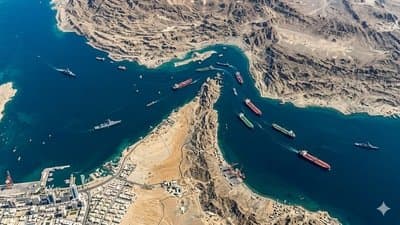
**US officials have maintained consistent opposition to any fees or tolls on transit through the Strait of Hormuz, an international waterway governed by freedom-of-navigation principles under international law.** In mid-July 2026, President Trump briefly floated the United States acting as “Guardian” of the strait and collecting a 20% cargo reimbursement for security costs, but quickly shifted to emphasizing Gulf state investment deals instead. Secretary of State Marco Rubio and other administration voices have repeatedly rejected monetizing passage, aligning with longstanding US policy against charges on such routes. Trader consensus on Polymarket reflects this stance, pricing a low probability (around 4-7%) that the US government will collect any such payment by year-end. Ongoing US-Iran negotiations and post-ceasefire arrangements focus on security frameworks and reopening traffic rather than US-controlled fees, with no recent legislative, executive, or diplomatic moves indicating a policy reversal. Scheduled diplomatic engagements and maritime security talks could still influence outcomes, though the structural preference for free transit remains the dominant factor.
Polymarket ডেটা রেফারেন্স করে পরীক্ষামূলক AI-জেনারেটেড সারাংশ। এটি ট্রেডিং পরামর্শ নয় এবং এই মার্কেট কীভাবে রেজলভ হয় তাতে কোনো ভূমিকা রাখে না। · আপডেটেড$983,541 Vol.
December 31
6%
$983,541 Vol.
December 31
6%
Any payment amount or rate will count. Payments may be monetary or in-kind (e.g., a share of cargo or oil) and may be collected directly by the US government or by an agent, contractor, or intermediary collecting on its behalf, provided the payment is made under a US-imposed fee or a compensation arrangement.
The announcement, signing, or establishment of a fee program, executive order, regulation, or collection mechanism will not by itself qualify; at least one payment must actually be received by the listed date, 11:59 PM ET.
Payments collected by Iran or any other party acting on its own behalf will not count. Payments under preexisting obligations, including US customs duties, tariffs on goods imported into the United States, or standard port charges, will not count unless newly imposed as a condition of Strait of Hormuz transit or protection.
The resolution sources will be official announcements from the government of the United States and a consensus of credible reporting.
মার্কেট ওপেন হয়েছে: Jul 13, 2026, 12:00 PM ET
রেজলভার
0x65070BE91...Any payment amount or rate will count. Payments may be monetary or in-kind (e.g., a share of cargo or oil) and may be collected directly by the US government or by an agent, contractor, or intermediary collecting on its behalf, provided the payment is made under a US-imposed fee or a compensation arrangement.
The announcement, signing, or establishment of a fee program, executive order, regulation, or collection mechanism will not by itself qualify; at least one payment must actually be received by the listed date, 11:59 PM ET.
Payments collected by Iran or any other party acting on its own behalf will not count. Payments under preexisting obligations, including US customs duties, tariffs on goods imported into the United States, or standard port charges, will not count unless newly imposed as a condition of Strait of Hormuz transit or protection.
The resolution sources will be official announcements from the government of the United States and a consensus of credible reporting.
রেজলভার
0x65070BE91...**US officials have maintained consistent opposition to any fees or tolls on transit through the Strait of Hormuz, an international waterway governed by freedom-of-navigation principles under international law.** In mid-July 2026, President Trump briefly floated the United States acting as “Guardian” of the strait and collecting a 20% cargo reimbursement for security costs, but quickly shifted to emphasizing Gulf state investment deals instead. Secretary of State Marco Rubio and other administration voices have repeatedly rejected monetizing passage, aligning with longstanding US policy against charges on such routes. Trader consensus on Polymarket reflects this stance, pricing a low probability (around 4-7%) that the US government will collect any such payment by year-end. Ongoing US-Iran negotiations and post-ceasefire arrangements focus on security frameworks and reopening traffic rather than US-controlled fees, with no recent legislative, executive, or diplomatic moves indicating a policy reversal. Scheduled diplomatic engagements and maritime security talks could still influence outcomes, though the structural preference for free transit remains the dominant factor.
Polymarket ডেটা রেফারেন্স করে পরীক্ষামূলক AI-জেনারেটেড সারাংশ। এটি ট্রেডিং পরামর্শ নয় এবং এই মার্কেট কীভাবে রেজলভ হয় তাতে কোনো ভূমিকা রাখে না। · আপডেটেড

বাহ্যিক লিংক থেকে সাবধান।
বাহ্যিক লিংক থেকে সাবধান।
সচরাচর জিজ্ঞাসা