

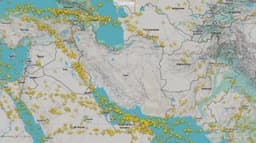
Saudi airspace has remained open to civil traffic despite recent Houthi missile and drone attacks linked to intensified fighting in Yemen, including a September 19, 2026 strike that damaged an Aramco fuel depot near Riyadh’s King Khalid International Airport and triggered the first air raid alerts in the capital in months. Southern airports such as Jazan, Abha, and Najran have faced repeated temporary closures this summer due to proximity to Houthi launch areas. Broader regional tensions stemming from U.S.-Iran hostilities have produced periodic disruptions, rerouting, and airline suspensions, though Saudi authorities have intercepted threats and issued all-clears without imposing a nationwide shutdown. Traders are monitoring Houthi advances in Yemen, potential further strikes on energy infrastructure or population centers, and any Saudi or coalition responses that could prompt extended restrictions or full closure.
Riepilogo sperimentale generato dall'AI con riferimento ai dati di Polymarket. Questo non è un consiglio di trading e non ha alcun ruolo nella risoluzione di questo mercato. · Aggiornato30 settembre
7%
31 ottobre
17%
31 dicembre
25%
$8,961 Vol.
30 settembre
7%
31 ottobre
17%
31 dicembre
25%
A qualifying closure occurs when the aviation or governmental authority responsible for overseeing the specified airspace region issues a Notice to Airmen (NOTAM), or other official order under the regulations of the jurisdiction responsible for that airspace region, which generally cancels or suspends commercial aviation across the specified airspace region, and such closure is not excluded under the exclusions provision below. A qualifying closure must apply generally to commercial flights transiting, arriving in, and departing from the specified airspace region. A closure is not disqualified because the order permits limited exceptions, including humanitarian, medical, repatriation, or emergency flights, or select flights authorized by the responsible authority, provided that commercial flights are prohibited by default, rather than permitted subject to conditions or restrictions.
The following are not qualifying closures: (i) closures due to weather, including volcanic and seismic activity; (ii) closures for holidays or religious observances; (iii) closures planned or announced before market creation; (iv) closures occurring on a regular cadence whose occurrence was determined before market creation, even if not announced; (v) closures resulting from the failure or malfunction of air traffic control, navigation, communications, power, or other technical systems; (vi) restrictions applying to aircraft by nationality, state of registry, operator, or ownership rather than to commercial traffic generally; (vii) closures of a subset of the specified airspace region, including geographic sectors and altitude bands; (viii) ground stops, flow restrictions, capacity reductions, or other air traffic management measures that delay or restrict traffic without closing the specified airspace region to commercial aviation; and (ix) warnings, no-fly zones, flight suspensions, or other restrictions imposed by any party other than the aviation or governmental authorities responsible for overseeing the specified airspace region.
A qualifying closure is deemed to occur at the time the closure takes effect, regardless of when the closure is announced or the order is issued. Where no effective time is included in the order, the closure is deemed to take effect at the time the order is issued.
The resolution sources for this market will be official information from the Saudi Arabian government, including the Ministry of Transport and Logistic Services, the General Authority of Civil Aviation (GACA), and Saudi Air Navigation Services (SANS), and a consensus of credible reporting.
Mercato aperto: Sep 19, 2026, 10:07 PM ET
Risolutore
0x65070BE91...A qualifying closure occurs when the aviation or governmental authority responsible for overseeing the specified airspace region issues a Notice to Airmen (NOTAM), or other official order under the regulations of the jurisdiction responsible for that airspace region, which generally cancels or suspends commercial aviation across the specified airspace region, and such closure is not excluded under the exclusions provision below. A qualifying closure must apply generally to commercial flights transiting, arriving in, and departing from the specified airspace region. A closure is not disqualified because the order permits limited exceptions, including humanitarian, medical, repatriation, or emergency flights, or select flights authorized by the responsible authority, provided that commercial flights are prohibited by default, rather than permitted subject to conditions or restrictions.
The following are not qualifying closures: (i) closures due to weather, including volcanic and seismic activity; (ii) closures for holidays or religious observances; (iii) closures planned or announced before market creation; (iv) closures occurring on a regular cadence whose occurrence was determined before market creation, even if not announced; (v) closures resulting from the failure or malfunction of air traffic control, navigation, communications, power, or other technical systems; (vi) restrictions applying to aircraft by nationality, state of registry, operator, or ownership rather than to commercial traffic generally; (vii) closures of a subset of the specified airspace region, including geographic sectors and altitude bands; (viii) ground stops, flow restrictions, capacity reductions, or other air traffic management measures that delay or restrict traffic without closing the specified airspace region to commercial aviation; and (ix) warnings, no-fly zones, flight suspensions, or other restrictions imposed by any party other than the aviation or governmental authorities responsible for overseeing the specified airspace region.
A qualifying closure is deemed to occur at the time the closure takes effect, regardless of when the closure is announced or the order is issued. Where no effective time is included in the order, the closure is deemed to take effect at the time the order is issued.
The resolution sources for this market will be official information from the Saudi Arabian government, including the Ministry of Transport and Logistic Services, the General Authority of Civil Aviation (GACA), and Saudi Air Navigation Services (SANS), and a consensus of credible reporting.
Risolutore
0x65070BE91...Saudi airspace has remained open to civil traffic despite recent Houthi missile and drone attacks linked to intensified fighting in Yemen, including a September 19, 2026 strike that damaged an Aramco fuel depot near Riyadh’s King Khalid International Airport and triggered the first air raid alerts in the capital in months. Southern airports such as Jazan, Abha, and Najran have faced repeated temporary closures this summer due to proximity to Houthi launch areas. Broader regional tensions stemming from U.S.-Iran hostilities have produced periodic disruptions, rerouting, and airline suspensions, though Saudi authorities have intercepted threats and issued all-clears without imposing a nationwide shutdown. Traders are monitoring Houthi advances in Yemen, potential further strikes on energy infrastructure or population centers, and any Saudi or coalition responses that could prompt extended restrictions or full closure.
Riepilogo sperimentale generato dall'AI con riferimento ai dati di Polymarket. Questo non è un consiglio di trading e non ha alcun ruolo nella risoluzione di questo mercato. · Aggiornato
Fai attenzione ai link esterni.
Fai attenzione ai link esterni.
Domande frequenti