
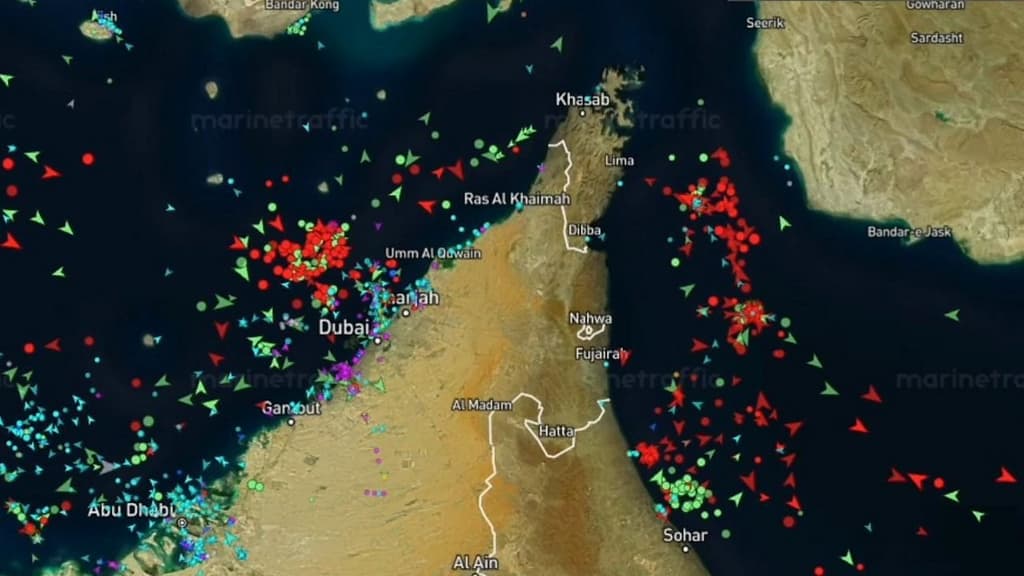
Escalating naval tensions in the Strait of Hormuz, a chokepoint for roughly 20-25% of global seaborne crude oil and LNG trade, have driven sharp volatility in energy prices and shipping rates since the February 2026 conflict onset. Recent August attacks on UAE-linked vessels and U.S. Central Command's ongoing blockade of Iranian ports—rerouting or disabling dozens of ships—have reinforced trader focus on freedom-of-navigation risks, with implied probabilities reflecting limited multinational warship transits amid Iranian warnings and U.S. enforcement. Oil benchmarks price in persistent supply disruption premiums, while tanker charter rates and insurance costs remain elevated, pressuring downstream refining margins and global inflation expectations. Key near-term catalysts include the August 31 resolution window and any shifts in U.S.-Iran blockade dynamics or allied naval commitments that could alter energy market risk assessments.
Експериментальне резюме, згенероване ШІ з посиланням на дані Polymarket. Це не торгова порада і не впливає на вирішення цього ринку. · ОновленоWhich countries will send warships through the Strait of Hormuz by August 31?
Which countries will send warships through the Strait of Hormuz by August 31?
$247,005 Обс.

US
7%

France
1%

UK
1%

Italy
1%

Netherlands
1%

Australia
1%

Greece
1%

Germany
1%
$247,005 Обс.
US
7%
France
1%
UK
1%
Italy
1%
Netherlands
1%
Australia
1%
Greece
1%
Germany
1%
A "warship transit" is defined as a military vessel passing through the Strait of Hormuz. Military cargo or support vessels will be considered “warships”; however, commercial or civilian vessels will not qualify.
For the purposes of this market, only transits through the Strait of Hormuz will be considered, defined as passage through the narrowest portion of the waterway between Iran and Oman. Operations solely in the Persian Gulf, Gulf of Oman, or Arabian Sea without passage through this narrowest section will not qualify.
Official confirmation by a national government or its military that its vessels transited through the Strait of Hormuz during the specified timeframe will resolve this market immediately. An overwhelming consensus of credible reporting confirming that such a transit occurred during the specified timeframe will also suffice.
Qualifying confirmations must be made within this markets above specified timeframe and include official announcements that a country has deployed naval vessels to transit or escort shipping through the Strait of Hormuz.
Confirmations referring only to naval presence in the broader region, including the Persian Gulf, Gulf of Oman, or Arabian Sea, without confirmed transit through the Strait itself, as well as aerial operations, cyber operations, or actions by proxies or third parties, will not alone qualify.
The primary resolution source for this market will be official information by the respective national governments or their militaries; however, an overwhelming consensus of credible reporting will also suffice.
Ринок відкрито: Jul 31, 2026, 10:14 AM ET
Resolver
0x65070BE91...A "warship transit" is defined as a military vessel passing through the Strait of Hormuz. Military cargo or support vessels will be considered “warships”; however, commercial or civilian vessels will not qualify.
For the purposes of this market, only transits through the Strait of Hormuz will be considered, defined as passage through the narrowest portion of the waterway between Iran and Oman. Operations solely in the Persian Gulf, Gulf of Oman, or Arabian Sea without passage through this narrowest section will not qualify.
Official confirmation by a national government or its military that its vessels transited through the Strait of Hormuz during the specified timeframe will resolve this market immediately. An overwhelming consensus of credible reporting confirming that such a transit occurred during the specified timeframe will also suffice.
Qualifying confirmations must be made within this markets above specified timeframe and include official announcements that a country has deployed naval vessels to transit or escort shipping through the Strait of Hormuz.
Confirmations referring only to naval presence in the broader region, including the Persian Gulf, Gulf of Oman, or Arabian Sea, without confirmed transit through the Strait itself, as well as aerial operations, cyber operations, or actions by proxies or third parties, will not alone qualify.
The primary resolution source for this market will be official information by the respective national governments or their militaries; however, an overwhelming consensus of credible reporting will also suffice.
Resolver
0x65070BE91...Escalating naval tensions in the Strait of Hormuz, a chokepoint for roughly 20-25% of global seaborne crude oil and LNG trade, have driven sharp volatility in energy prices and shipping rates since the February 2026 conflict onset. Recent August attacks on UAE-linked vessels and U.S. Central Command's ongoing blockade of Iranian ports—rerouting or disabling dozens of ships—have reinforced trader focus on freedom-of-navigation risks, with implied probabilities reflecting limited multinational warship transits amid Iranian warnings and U.S. enforcement. Oil benchmarks price in persistent supply disruption premiums, while tanker charter rates and insurance costs remain elevated, pressuring downstream refining margins and global inflation expectations. Key near-term catalysts include the August 31 resolution window and any shifts in U.S.-Iran blockade dynamics or allied naval commitments that could alter energy market risk assessments.
Експериментальне резюме, згенероване ШІ з посиланням на дані Polymarket. Це не торгова порада і не впливає на вирішення цього ринку. · Оновлено
Обережно з зовнішніми посиланнями.
Обережно з зовнішніми посиланнями.
Часті запитання