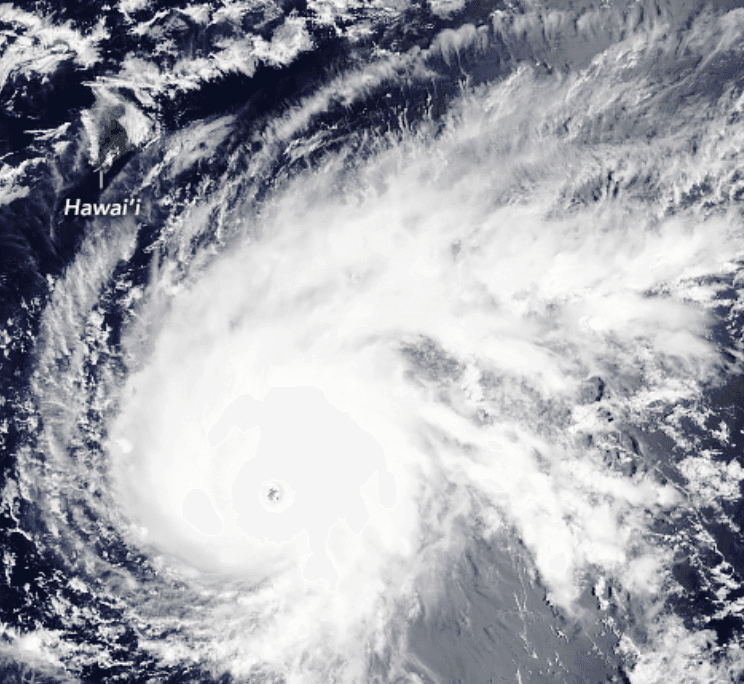
Hawaii's central Pacific location and typical steering patterns driven by subtropical ridges make direct hurricane landfalls (sustained winds of 74 mph or higher on the Saffir-Simpson scale) exceptionally rare, with only two confirmed modern instances—Hurricane Dot in 1959 and Iniki in 1992. Recent tropical systems such as Iselle (2014), Darby (2016), and Olivia (2018) reached the islands only as tropical storms. The 2026 Central Pacific season is forecast above normal by NOAA with 5–13 cyclones amid El Niño conditions, yet most weaken or recurve before impact, consistent with long-term climatology showing just a handful of close approaches per decade. With roughly four months remaining in the season, trader consensus at 90.5% for no landfall reflects this low base rate. A late-season intensification and precise track alignment could still produce a qualifying event before January 1, 2027.
Experimentelle KI-generierte Zusammenfassung mit Polymarket-Daten. Dies ist keine Handelsberatung und spielt keine Rolle bei der Auflösung dieses Marktes. · AktualisiertWird ein Hurrikan vor 2027 auf Hawaii landen?
Wird ein Hurrikan vor 2027 auf Hawaii landen?
Ja
$11,535 Vol.
$11,535 Vol.
Ja
$11,535 Vol.
$11,535 Vol.
A hurricane is a tropical cyclone with maximum sustained winds of 74 mph or greater (Category 1 or higher on the Saffir-Simpson Hurricane Wind Scale), as described at https://www.nhc.noaa.gov/aboutsshws.php, and a hurricane landfall is said to occur when the hurricane's surface center intersects with the coastline, as described at https://www.nhc.noaa.gov/aboutgloss.shtml#LANDFALL. A storm must hold hurricane strength (Category 1 or higher on the Saffir-Simpson scale) at the moment its surface center intersects the coastline for that landfall to qualify.
"Hawaii" means the entire State of Hawaii as recognized under U.S. law, including the main Hawaiian Islands (Hawaiʻi, Maui, Oʻahu, Kauaʻi, Molokaʻi, Lānaʻi, Niʻihau, and Kahoʻolawe) and the Northwestern Hawaiian Islands (including Midway Atoll and the Papahānaumokuākea Marine National Monument).
The wind speed at the moment of landfall will be determined from the CPHC advisory or Special Advisory in effect at the time closest to the reported landfall time; where no advisory covers that exact moment, the most recent advisory issued prior to landfall governs.
This market may resolve based on the initial CPHC advisory reporting a qualifying landfall regardless of any later advisory, retraction, best-track revision, or reanalysis that revises that storm's intensity downward at the time of landfall. However, if a subsequent advisory or correction identifies a qualifying landfall that was not reflected in initial reporting, this market will resolve to "Yes" based on that correction.
Markt eröffnet: Jul 24, 2026, 11:28 AM ET
Resolver
0x65070BE91...A hurricane is a tropical cyclone with maximum sustained winds of 74 mph or greater (Category 1 or higher on the Saffir-Simpson Hurricane Wind Scale), as described at https://www.nhc.noaa.gov/aboutsshws.php, and a hurricane landfall is said to occur when the hurricane's surface center intersects with the coastline, as described at https://www.nhc.noaa.gov/aboutgloss.shtml#LANDFALL. A storm must hold hurricane strength (Category 1 or higher on the Saffir-Simpson scale) at the moment its surface center intersects the coastline for that landfall to qualify.
"Hawaii" means the entire State of Hawaii as recognized under U.S. law, including the main Hawaiian Islands (Hawaiʻi, Maui, Oʻahu, Kauaʻi, Molokaʻi, Lānaʻi, Niʻihau, and Kahoʻolawe) and the Northwestern Hawaiian Islands (including Midway Atoll and the Papahānaumokuākea Marine National Monument).
The wind speed at the moment of landfall will be determined from the CPHC advisory or Special Advisory in effect at the time closest to the reported landfall time; where no advisory covers that exact moment, the most recent advisory issued prior to landfall governs.
This market may resolve based on the initial CPHC advisory reporting a qualifying landfall regardless of any later advisory, retraction, best-track revision, or reanalysis that revises that storm's intensity downward at the time of landfall. However, if a subsequent advisory or correction identifies a qualifying landfall that was not reflected in initial reporting, this market will resolve to "Yes" based on that correction.
Resolver
0x65070BE91...Hawaii's central Pacific location and typical steering patterns driven by subtropical ridges make direct hurricane landfalls (sustained winds of 74 mph or higher on the Saffir-Simpson scale) exceptionally rare, with only two confirmed modern instances—Hurricane Dot in 1959 and Iniki in 1992. Recent tropical systems such as Iselle (2014), Darby (2016), and Olivia (2018) reached the islands only as tropical storms. The 2026 Central Pacific season is forecast above normal by NOAA with 5–13 cyclones amid El Niño conditions, yet most weaken or recurve before impact, consistent with long-term climatology showing just a handful of close approaches per decade. With roughly four months remaining in the season, trader consensus at 90.5% for no landfall reflects this low base rate. A late-season intensification and precise track alignment could still produce a qualifying event before January 1, 2027.
Experimentelle KI-generierte Zusammenfassung mit Polymarket-Daten. Dies ist keine Handelsberatung und spielt keine Rolle bei der Auflösung dieses Marktes. · Aktualisiert

Vorsicht bei externen Links.
Vorsicht bei externen Links.
Häufig gestellte Fragen