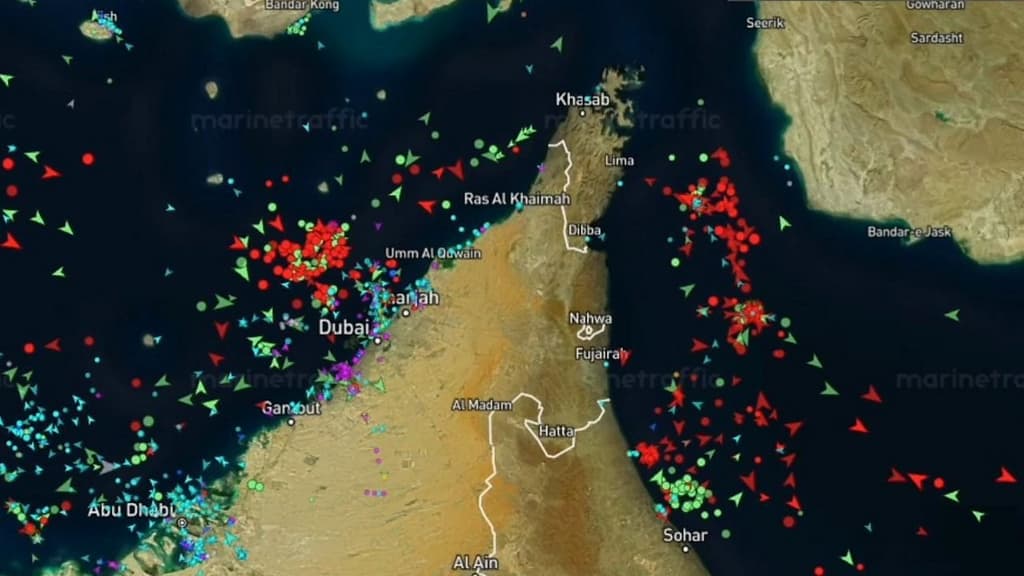
Ongoing US-Iran tensions and Iranian assertions of control continue to suppress commercial traffic through the Strait of Hormuz, keeping daily transits at roughly 10-14 vessels—well below the pre-conflict average of 60 or more—though not at absolute zero. Following the fragile June 2026 memorandum of understanding and subsequent US naval blockade reimposition in July, Iran has demanded the lifting of sanctions, blockades, and regional military presence before normalizing passage, while routing compliant vessels through its territorial waters and targeting noncompliant ones. Recent attacks on shipping and Iranian statements on August 8 reiterating closure conditions have sustained uncertainty, with many transits occurring AIS-dark amid mine risks and enforcement measures. Traders monitor diplomatic talks on future strait administration and any escalation in naval activity, as even limited reopenings under Iranian protocols or renewed blockades could alter the likelihood of a complete zero-transit day.
Ringkasan eksperimental yang dihasilkan AI dengan referensi data Polymarket. Ini bukan saran trading dan tidak berperan dalam bagaimana pasar ini diselesaikan. · Diperbarui0 ships transit Hormuz on any date by..?
0 ships transit Hormuz on any date by..?
$725,500 Vol.
August 31
19%
$725,500 Vol.
August 31
19%
Transit calls include container, dry bulk, roll-on/roll-off, general cargo, and tanker ships. Ships not reported by IMF PortWatch will not be considered.
This market will resolve as soon as IMF PortWatch publishes a daily number of transit calls equal to 0, or once complete data has been published for the specified period without such a publication. If complete data for the specified period has not been published within 28 calendar days of the end of the specified period, this market will resolve based on data published up to that point.
In case of obvious data integrity issues (i.e., erroneous data), the market may remain open until the end of the third calendar day (ET) after the date on which such data is first released to allow for corrections. Data integrity issues refer only to clerical or other similar errors in the underlying data, and do not include cases where IMF PortWatch differs from alternative sources. Revisions to previously published data points made within this market’s timeframe will be considered. However, they will not disqualify a previously published data point from qualifying except in the case of data integrity issues.
The resolution source for this market will be IMF PortWatch, specifically the transit calls data published for the Strait of Hormuz at https://portwatch.imf.org/pages/cb5856222a5b4105adc6ee7e880a1730, both in the chart and through downloadable files.
Pasar Dibuka: Jul 29, 2026, 12:28 PM ET
Resolver
0x65070BE91...Transit calls include container, dry bulk, roll-on/roll-off, general cargo, and tanker ships. Ships not reported by IMF PortWatch will not be considered.
This market will resolve as soon as IMF PortWatch publishes a daily number of transit calls equal to 0, or once complete data has been published for the specified period without such a publication. If complete data for the specified period has not been published within 28 calendar days of the end of the specified period, this market will resolve based on data published up to that point.
In case of obvious data integrity issues (i.e., erroneous data), the market may remain open until the end of the third calendar day (ET) after the date on which such data is first released to allow for corrections. Data integrity issues refer only to clerical or other similar errors in the underlying data, and do not include cases where IMF PortWatch differs from alternative sources. Revisions to previously published data points made within this market’s timeframe will be considered. However, they will not disqualify a previously published data point from qualifying except in the case of data integrity issues.
The resolution source for this market will be IMF PortWatch, specifically the transit calls data published for the Strait of Hormuz at https://portwatch.imf.org/pages/cb5856222a5b4105adc6ee7e880a1730, both in the chart and through downloadable files.
Resolver
0x65070BE91...Ongoing US-Iran tensions and Iranian assertions of control continue to suppress commercial traffic through the Strait of Hormuz, keeping daily transits at roughly 10-14 vessels—well below the pre-conflict average of 60 or more—though not at absolute zero. Following the fragile June 2026 memorandum of understanding and subsequent US naval blockade reimposition in July, Iran has demanded the lifting of sanctions, blockades, and regional military presence before normalizing passage, while routing compliant vessels through its territorial waters and targeting noncompliant ones. Recent attacks on shipping and Iranian statements on August 8 reiterating closure conditions have sustained uncertainty, with many transits occurring AIS-dark amid mine risks and enforcement measures. Traders monitor diplomatic talks on future strait administration and any escalation in naval activity, as even limited reopenings under Iranian protocols or renewed blockades could alter the likelihood of a complete zero-transit day.
Ringkasan eksperimental yang dihasilkan AI dengan referensi data Polymarket. Ini bukan saran trading dan tidak berperan dalam bagaimana pasar ini diselesaikan. · Diperbarui
Hati-hati dengan link eksternal.
Hati-hati dengan link eksternal.
Pertanyaan yang Sering Diajukan