
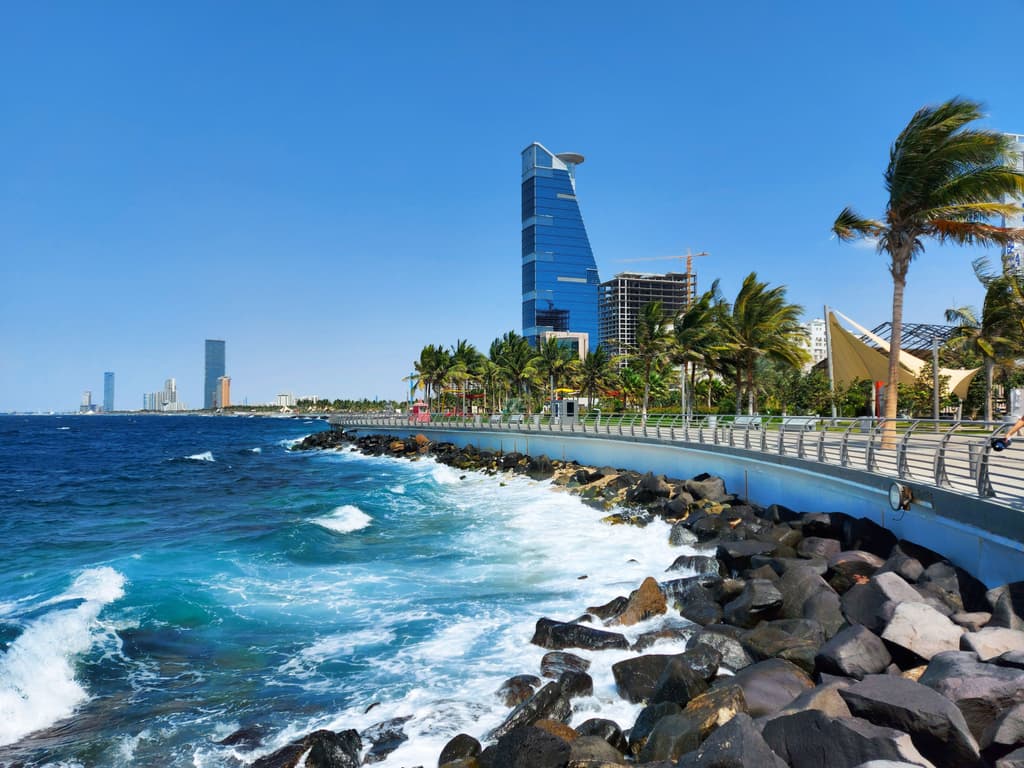
**Forecast models for Jeddah on September 17, 2026, currently cluster daily maximum temperatures in the mid-to-upper 30s °C, with peaks most often projected between 36–38 °C.** This distribution aligns with the closely matched market-implied probabilities (36 °C at 29.5 %, 37 °C at 27.0 %, 38 °C at 21.5 %), reflecting modest uncertainty in the precise timing and intensity of the daily peak. Jeddah’s Red Sea coastal setting introduces key moderating influences: persistent sea breezes from the west or northwest typically cap extreme heating by advecting slightly cooler, humid maritime air, while high humidity (often 50–70 % during peak hours) limits surface warming through reduced sensible heat flux. September climatology features strong solar insolation near the end of the hot season, with historical September maxima around 37–39 °C, but short-term variability arises from subtle shifts in wind speed, cloud cover, or boundary-layer mixing. Recent days show a minor cooling trend from mid-September peaks near 40–41 °C, consistent with strengthening onshore flow. Differentiation among the leading outcomes hinges on small forecast differences in maximum wind gusts, dew-point depression, and any thin high-cloud interference that could shave 1–2 °C off the peak. Official guidance from agencies such as the Saudi National Center for Meteorology will refine these details in the final 24–48 hours, with traders monitoring updates for any late adjustments in steering patterns or local thermal gradients.
Ringkasan eksperimental yang dihasilkan AI dengan referensi data Polymarket. Ini bukan saran trading dan tidak berperan dalam bagaimana pasar ini diselesaikan. · DiperbaruiHighest temperature in Jeddah on September 17?
Highest temperature in Jeddah on September 17?
39°C or higher 29%
37°C 27%
38°C 25%
36°C 24%
29°C or below
<1%
30°C
<1%
31°C
<1%
32°C
<1%
33°C
<1%
34°C
4%
35°C
10%
36°C
24%
37°C
27%
38°C
25%
39°C or higher
29%
39°C or higher 29%
37°C 27%
38°C 25%
36°C 24%
29°C or below
<1%
30°C
<1%
31°C
<1%
32°C
<1%
33°C
<1%
34°C
4%
35°C
10%
36°C
24%
37°C
27%
38°C
25%
39°C or higher
29%
The resolution source for this market will be information from NOAA, specifically the highest reading under the "Temp" column for all times on this day, available here: https://www.weather.gov/wrh/timeseries?site=oejn
If NOAA data for the observation date is unavailable by 11:59 PM ET on the day following the observation date, the Weather Underground Daily Observations table will be used as the resolution source.
In the event that there is no data for the observation date by 11:59 PM ET on the day following the observation date, this market will resolve to the lowest bracket.
To toggle between Fahrenheit and Celsius, click the "Switch to Metric Units" button until the relevant table displays °C.
This market will resolve once the first data point for the following date has been published on the resolution source, or by 11:59 PM ET on the day following the observation date, whichever comes first.
The resolution source for this market measures temperatures to whole degrees Celsius (eg, 9°C). Thus, this is the level of precision that will be used when resolving the market.
Revisions to temperatures recorded within this market's timeframe will be considered until the first datapoint for the following date has been published, after which any alterations will not be considered.
Pasar Dibuka: Sep 15, 2026, 12:58 AM ET
Sumber Resolusi
https://www.weather.gov/wrh/timeseries?site=oejnResolver
0x69c47De9D...The resolution source for this market will be information from NOAA, specifically the highest reading under the "Temp" column for all times on this day, available here: https://www.weather.gov/wrh/timeseries?site=oejn
If NOAA data for the observation date is unavailable by 11:59 PM ET on the day following the observation date, the Weather Underground Daily Observations table will be used as the resolution source.
In the event that there is no data for the observation date by 11:59 PM ET on the day following the observation date, this market will resolve to the lowest bracket.
To toggle between Fahrenheit and Celsius, click the "Switch to Metric Units" button until the relevant table displays °C.
This market will resolve once the first data point for the following date has been published on the resolution source, or by 11:59 PM ET on the day following the observation date, whichever comes first.
The resolution source for this market measures temperatures to whole degrees Celsius (eg, 9°C). Thus, this is the level of precision that will be used when resolving the market.
Revisions to temperatures recorded within this market's timeframe will be considered until the first datapoint for the following date has been published, after which any alterations will not be considered.
Sumber Resolusi
https://www.weather.gov/wrh/timeseries?site=oejnResolver
0x69c47De9D...**Forecast models for Jeddah on September 17, 2026, currently cluster daily maximum temperatures in the mid-to-upper 30s °C, with peaks most often projected between 36–38 °C.** This distribution aligns with the closely matched market-implied probabilities (36 °C at 29.5 %, 37 °C at 27.0 %, 38 °C at 21.5 %), reflecting modest uncertainty in the precise timing and intensity of the daily peak. Jeddah’s Red Sea coastal setting introduces key moderating influences: persistent sea breezes from the west or northwest typically cap extreme heating by advecting slightly cooler, humid maritime air, while high humidity (often 50–70 % during peak hours) limits surface warming through reduced sensible heat flux. September climatology features strong solar insolation near the end of the hot season, with historical September maxima around 37–39 °C, but short-term variability arises from subtle shifts in wind speed, cloud cover, or boundary-layer mixing. Recent days show a minor cooling trend from mid-September peaks near 40–41 °C, consistent with strengthening onshore flow. Differentiation among the leading outcomes hinges on small forecast differences in maximum wind gusts, dew-point depression, and any thin high-cloud interference that could shave 1–2 °C off the peak. Official guidance from agencies such as the Saudi National Center for Meteorology will refine these details in the final 24–48 hours, with traders monitoring updates for any late adjustments in steering patterns or local thermal gradients.
Ringkasan eksperimental yang dihasilkan AI dengan referensi data Polymarket. Ini bukan saran trading dan tidak berperan dalam bagaimana pasar ini diselesaikan. · Diperbarui
Hati-hati dengan link eksternal.
Hati-hati dengan link eksternal.
Pertanyaan yang Sering Diajukan