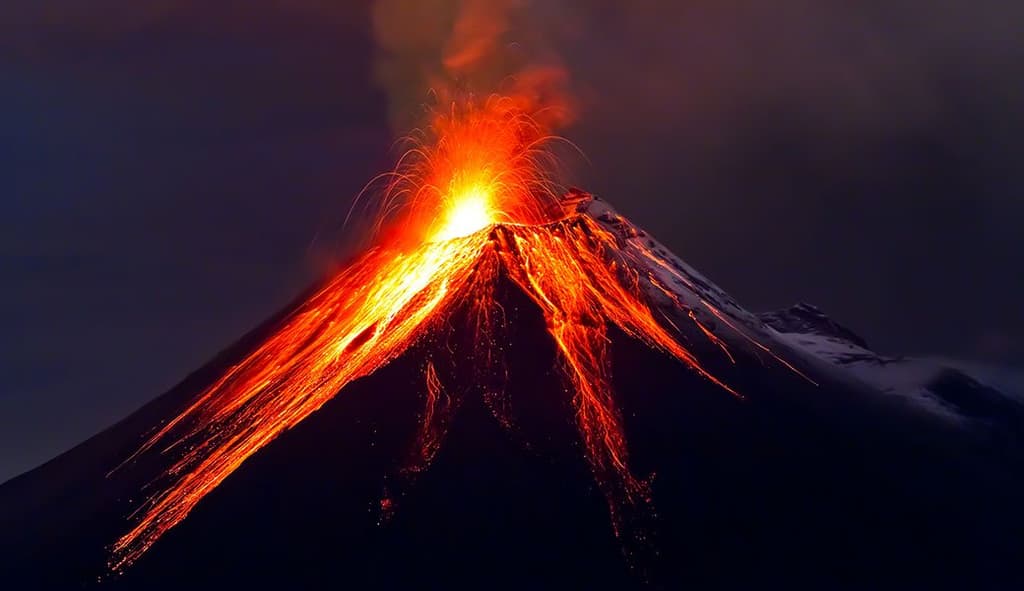
**Large eruptions with VEI ≥4 remain statistically uncommon, with global rates typically averaging fewer than one to two per year over recent decades.** As of mid-August 2026, no confirmed VEI ≥4 events have been widely reported, supporting the market's strong 70.5% implied probability for zero such eruptions by year-end. Most 2026 activity documented by the Smithsonian Global Volcanism Program and monitoring agencies has involved smaller explosive or effusive events at volcanoes such as Dukono (Indonesia) and ongoing systems in Iceland or the Philippines, generally rated VEI 2–3 or lower. VEI 4 requires substantial eruptive volume (>0.1 km³) and plume heights exceeding 10 km, conditions that demand sustained high gas pressures and viscous magma—factors rarely aligned simultaneously across the ~50–60 volcanoes that erupt annually. Trader consensus favoring zero or one (combined ~89.5%) reflects both historical precedent and the absence of escalating unrest at high-risk systems. Remaining months could see shifts only if new satellite or seismic data reveal rapid pressurization at stratovolcanoes or calderas, but current official reports show no such indicators.
สรุปจาก AI ทดลองที่อ้างอิงข้อมูลจาก Polymarket ไม่ใช่คำแนะนำในการเทรดและไม่มีผลต่อการตัดสินตลาดนี้ · อัปเดตแล้วภูเขาไฟระเบิดขนาดใหญ่ (VEI ≥ 4) กี่ครั้งในปี 2026?
ภูเขาไฟระเบิดขนาดใหญ่ (VEI ≥ 4) กี่ครั้งในปี 2026?
0 67%
1 21%
2 3.6%
5+ <1%
$1,156,068 ปริมาณ
$1,156,068 ปริมาณ
0
69%
1
21%
2
4%
3
1%
4
1%
5+
1%
0 67%
1 21%
2 3.6%
5+ <1%
$1,156,068 ปริมาณ
$1,156,068 ปริมาณ
0
69%
1
21%
2
4%
3
1%
4
1%
5+
1%
The primary resolution source will be the Smithsonian Institution Global Volcanism Program (GVP: https://volcano.si.edu/), specifically the cumulative figures for 2026 for VEI 4, VEI 5, and VEI 6 released on the page currently titled "Eruptions Avg 2000-2024 (N/T)" (https://volcano.si.edu/faq/index.cfm?question=eruptionsbyyear) as of March 31, 2027, 12 PM ET. Any prior updates will not be considered finalized.
If this dataset has not been updated to include all relevant events by March 31, 2027, or if the Smithsonian GVP becomes permanently unavailable, this market may resolve based on a consensus of credible scientific sources, including the U.S. Geological Survey (USGS), national or regional volcanic observatories, or credible reporting of a scientific consensus.
Note: Smithsonian Institution Global Volcanism Program databases, which include eruptions that reached the relevant threshold prior to this market’s timeframe (e.g., https://volcano.si.edu/faq/index.cfm?question=eruptionsbyyear&checkyear=2025), will not be considered.
ตลาดเปิดเมื่อ: Jan 2, 2026, 1:48 PM ET
Resolver
0x2F5e3684c...The primary resolution source will be the Smithsonian Institution Global Volcanism Program (GVP: https://volcano.si.edu/), specifically the cumulative figures for 2026 for VEI 4, VEI 5, and VEI 6 released on the page currently titled "Eruptions Avg 2000-2024 (N/T)" (https://volcano.si.edu/faq/index.cfm?question=eruptionsbyyear) as of March 31, 2027, 12 PM ET. Any prior updates will not be considered finalized.
If this dataset has not been updated to include all relevant events by March 31, 2027, or if the Smithsonian GVP becomes permanently unavailable, this market may resolve based on a consensus of credible scientific sources, including the U.S. Geological Survey (USGS), national or regional volcanic observatories, or credible reporting of a scientific consensus.
Note: Smithsonian Institution Global Volcanism Program databases, which include eruptions that reached the relevant threshold prior to this market’s timeframe (e.g., https://volcano.si.edu/faq/index.cfm?question=eruptionsbyyear&checkyear=2025), will not be considered.
Resolver
0x2F5e3684c...**Large eruptions with VEI ≥4 remain statistically uncommon, with global rates typically averaging fewer than one to two per year over recent decades.** As of mid-August 2026, no confirmed VEI ≥4 events have been widely reported, supporting the market's strong 70.5% implied probability for zero such eruptions by year-end. Most 2026 activity documented by the Smithsonian Global Volcanism Program and monitoring agencies has involved smaller explosive or effusive events at volcanoes such as Dukono (Indonesia) and ongoing systems in Iceland or the Philippines, generally rated VEI 2–3 or lower. VEI 4 requires substantial eruptive volume (>0.1 km³) and plume heights exceeding 10 km, conditions that demand sustained high gas pressures and viscous magma—factors rarely aligned simultaneously across the ~50–60 volcanoes that erupt annually. Trader consensus favoring zero or one (combined ~89.5%) reflects both historical precedent and the absence of escalating unrest at high-risk systems. Remaining months could see shifts only if new satellite or seismic data reveal rapid pressurization at stratovolcanoes or calderas, but current official reports show no such indicators.
สรุปจาก AI ทดลองที่อ้างอิงข้อมูลจาก Polymarket ไม่ใช่คำแนะนำในการเทรดและไม่มีผลต่อการตัดสินตลาดนี้ · อัปเดตแล้ว

ระวังลิงก์ภายนอก
ระวังลิงก์ภายนอก
คำถามที่พบบ่อย