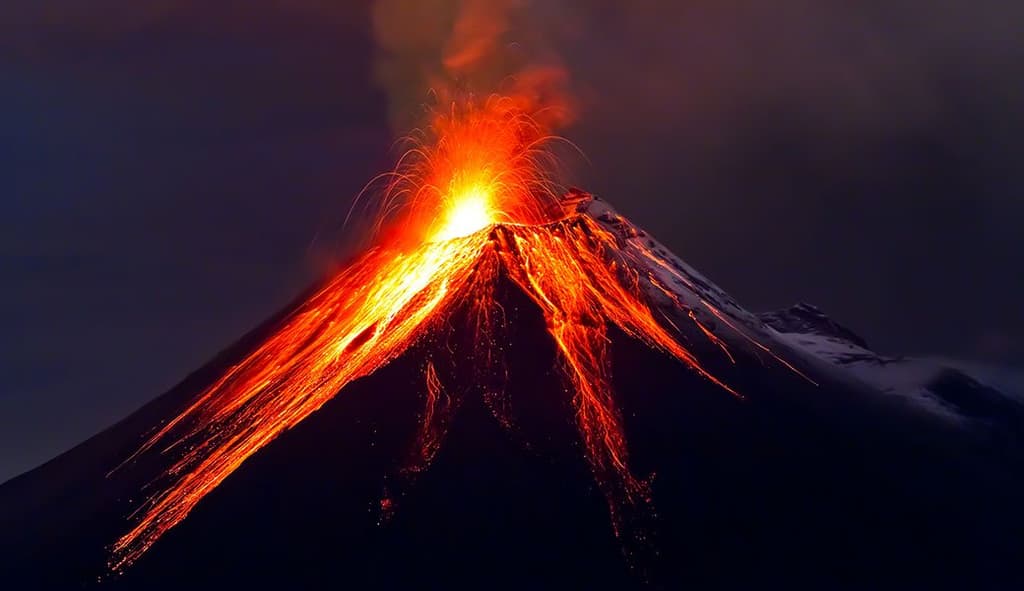
Trader consensus favoring zero VEI ≥4 eruptions in 2026 (57.5% implied probability) stems primarily from the absence of any confirmed events meeting that threshold through mid-August, despite dozens of lower-intensity eruptions worldwide. VEI 4 events require substantial tephra volumes (≥0.1 km³) and plume heights often exceeding 10 km, criteria that ongoing activity at sites like Indonesia’s Dukono (VEI 3) and Russia’s Sheveluch (high ash plumes but sub-VEI 4 episodes) has not yet satisfied. Historical baselines show such eruptions occur irregularly—typically one to a few per year on average—yet 2026 monitoring data from the Smithsonian Global Volcanism Program and national observatories indicate predominantly effusive or moderate explosive behavior so far. This scarcity, combined with typical year-to-year variability and no major escalation signals in recent USGS or PVMBG reports, underpins the market’s strong lean toward zero or one outcome while leaving room for late-year surprises at restless systems.
Résumé expérimental généré par IA à partir des données Polymarket. Ceci n'est pas un conseil de trading et ne joue aucun rôle dans la résolution de ce marché. · Mis à jourCombien de grandes éruptions volcaniques (VEI ≥4) en 2026 ?
Combien de grandes éruptions volcaniques (VEI ≥4) en 2026 ?
0 67%
1 19%
2 3.6%
5+ <1%
$1,156,063 Vol.
$1,156,063 Vol.
0
60%
1
19%
2
4%
3
1%
4
1%
5+
1%
0 67%
1 19%
2 3.6%
5+ <1%
$1,156,063 Vol.
$1,156,063 Vol.
0
60%
1
19%
2
4%
3
1%
4
1%
5+
1%
The primary resolution source will be the Smithsonian Institution Global Volcanism Program (GVP: https://volcano.si.edu/), specifically the cumulative figures for 2026 for VEI 4, VEI 5, and VEI 6 released on the page currently titled "Eruptions Avg 2000-2024 (N/T)" (https://volcano.si.edu/faq/index.cfm?question=eruptionsbyyear) as of March 31, 2027, 12 PM ET. Any prior updates will not be considered finalized.
If this dataset has not been updated to include all relevant events by March 31, 2027, or if the Smithsonian GVP becomes permanently unavailable, this market may resolve based on a consensus of credible scientific sources, including the U.S. Geological Survey (USGS), national or regional volcanic observatories, or credible reporting of a scientific consensus.
Note: Smithsonian Institution Global Volcanism Program databases, which include eruptions that reached the relevant threshold prior to this market’s timeframe (e.g., https://volcano.si.edu/faq/index.cfm?question=eruptionsbyyear&checkyear=2025), will not be considered.
Marché ouvert : Jan 2, 2026, 1:48 PM ET
Resolver
0x2F5e3684c...The primary resolution source will be the Smithsonian Institution Global Volcanism Program (GVP: https://volcano.si.edu/), specifically the cumulative figures for 2026 for VEI 4, VEI 5, and VEI 6 released on the page currently titled "Eruptions Avg 2000-2024 (N/T)" (https://volcano.si.edu/faq/index.cfm?question=eruptionsbyyear) as of March 31, 2027, 12 PM ET. Any prior updates will not be considered finalized.
If this dataset has not been updated to include all relevant events by March 31, 2027, or if the Smithsonian GVP becomes permanently unavailable, this market may resolve based on a consensus of credible scientific sources, including the U.S. Geological Survey (USGS), national or regional volcanic observatories, or credible reporting of a scientific consensus.
Note: Smithsonian Institution Global Volcanism Program databases, which include eruptions that reached the relevant threshold prior to this market’s timeframe (e.g., https://volcano.si.edu/faq/index.cfm?question=eruptionsbyyear&checkyear=2025), will not be considered.
Resolver
0x2F5e3684c...Trader consensus favoring zero VEI ≥4 eruptions in 2026 (57.5% implied probability) stems primarily from the absence of any confirmed events meeting that threshold through mid-August, despite dozens of lower-intensity eruptions worldwide. VEI 4 events require substantial tephra volumes (≥0.1 km³) and plume heights often exceeding 10 km, criteria that ongoing activity at sites like Indonesia’s Dukono (VEI 3) and Russia’s Sheveluch (high ash plumes but sub-VEI 4 episodes) has not yet satisfied. Historical baselines show such eruptions occur irregularly—typically one to a few per year on average—yet 2026 monitoring data from the Smithsonian Global Volcanism Program and national observatories indicate predominantly effusive or moderate explosive behavior so far. This scarcity, combined with typical year-to-year variability and no major escalation signals in recent USGS or PVMBG reports, underpins the market’s strong lean toward zero or one outcome while leaving room for late-year surprises at restless systems.
Résumé expérimental généré par IA à partir des données Polymarket. Ceci n'est pas un conseil de trading et ne joue aucun rôle dans la résolution de ce marché. · Mis à jour

Méfiez-vous des liens externes.
Méfiez-vous des liens externes.
Questions fréquentes