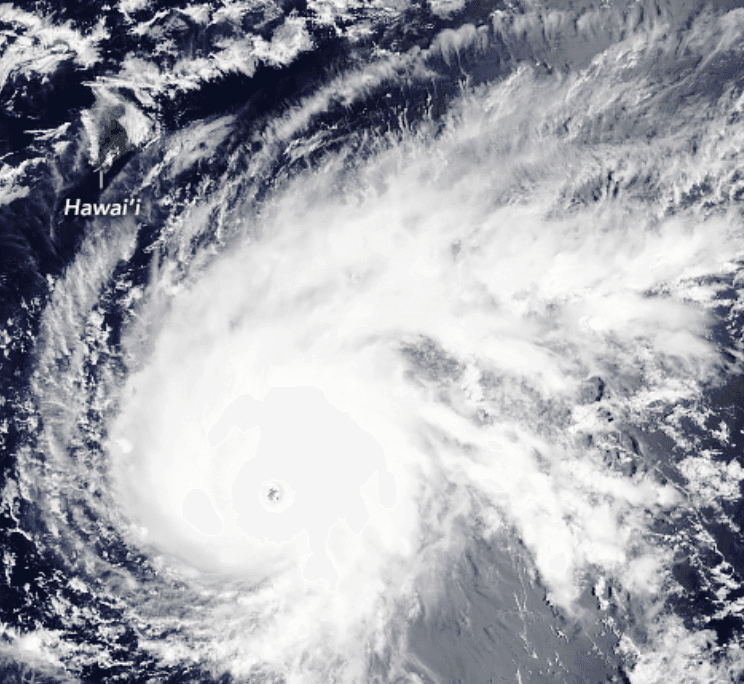
Current uncertainty around Tropical Storm Lala's track and intensification drives the 66% market-implied odds against a hurricane landfall in Hawaii before 2027. National Hurricane Center guidance shows Lala likely strengthening to hurricane strength near the Big Island this weekend, yet models diverge on whether the core tracks directly over land or passes south, limiting the chance of sustained hurricane-force winds on the islands. Historically, Hawaii experiences only rare direct hurricane strikes—Iniki in 1992 remains the most recent—despite an average of four to five central Pacific tropical cyclones annually. NOAA's above-normal 2026 outlook for the basin reflects elevated activity tied to El Niño conditions, but prevailing steering patterns and island-induced weakening reduce landfall probability. Revised model runs and NHC updates over the next 48 hours represent the key near-term catalysts.
Experimental AI-generated summary referencing Polymarket data. This is not trading advice and plays no role in how this market resolves. · UpdatedWill a hurricane make landfall in Hawaii before 2027?
Will a hurricane make landfall in Hawaii before 2027?
A hurricane is a tropical cyclone with maximum sustained winds of 74 mph or greater (Category 1 or higher on the Saffir-Simpson Hurricane Wind Scale), as described at https://www.nhc.noaa.gov/aboutsshws.php, and a hurricane landfall is said to occur when the hurricane's surface center intersects with the coastline, as described at https://www.nhc.noaa.gov/aboutgloss.shtml#LANDFALL. A storm must hold hurricane strength (Category 1 or higher on the Saffir-Simpson scale) at the moment its surface center intersects the coastline for that landfall to qualify.
"Hawaii" means the entire State of Hawaii as recognized under U.S. law, including the main Hawaiian Islands (Hawaiʻi, Maui, Oʻahu, Kauaʻi, Molokaʻi, Lānaʻi, Niʻihau, and Kahoʻolawe) and the Northwestern Hawaiian Islands (including Midway Atoll and the Papahānaumokuākea Marine National Monument).
The wind speed at the moment of landfall will be determined from the CPHC advisory or Special Advisory in effect at the time closest to the reported landfall time; where no advisory covers that exact moment, the most recent advisory issued prior to landfall governs.
This market may resolve based on the initial CPHC advisory reporting a qualifying landfall regardless of any later advisory, retraction, best-track revision, or reanalysis that revises that storm's intensity downward at the time of landfall. However, if a subsequent advisory or correction identifies a qualifying landfall that was not reflected in initial reporting, this market will resolve to "Yes" based on that correction.
Market Opened: Jul 24, 2026, 11:28 AM ET
Resolver
0x65070BE91...A hurricane is a tropical cyclone with maximum sustained winds of 74 mph or greater (Category 1 or higher on the Saffir-Simpson Hurricane Wind Scale), as described at https://www.nhc.noaa.gov/aboutsshws.php, and a hurricane landfall is said to occur when the hurricane's surface center intersects with the coastline, as described at https://www.nhc.noaa.gov/aboutgloss.shtml#LANDFALL. A storm must hold hurricane strength (Category 1 or higher on the Saffir-Simpson scale) at the moment its surface center intersects the coastline for that landfall to qualify.
"Hawaii" means the entire State of Hawaii as recognized under U.S. law, including the main Hawaiian Islands (Hawaiʻi, Maui, Oʻahu, Kauaʻi, Molokaʻi, Lānaʻi, Niʻihau, and Kahoʻolawe) and the Northwestern Hawaiian Islands (including Midway Atoll and the Papahānaumokuākea Marine National Monument).
The wind speed at the moment of landfall will be determined from the CPHC advisory or Special Advisory in effect at the time closest to the reported landfall time; where no advisory covers that exact moment, the most recent advisory issued prior to landfall governs.
This market may resolve based on the initial CPHC advisory reporting a qualifying landfall regardless of any later advisory, retraction, best-track revision, or reanalysis that revises that storm's intensity downward at the time of landfall. However, if a subsequent advisory or correction identifies a qualifying landfall that was not reflected in initial reporting, this market will resolve to "Yes" based on that correction.
Resolver
0x65070BE91...Current uncertainty around Tropical Storm Lala's track and intensification drives the 66% market-implied odds against a hurricane landfall in Hawaii before 2027. National Hurricane Center guidance shows Lala likely strengthening to hurricane strength near the Big Island this weekend, yet models diverge on whether the core tracks directly over land or passes south, limiting the chance of sustained hurricane-force winds on the islands. Historically, Hawaii experiences only rare direct hurricane strikes—Iniki in 1992 remains the most recent—despite an average of four to five central Pacific tropical cyclones annually. NOAA's above-normal 2026 outlook for the basin reflects elevated activity tied to El Niño conditions, but prevailing steering patterns and island-induced weakening reduce landfall probability. Revised model runs and NHC updates over the next 48 hours represent the key near-term catalysts.
Experimental AI-generated summary referencing Polymarket data. This is not trading advice and plays no role in how this market resolves. · Updated

Beware of external links.
Beware of external links.
Frequently Asked Questions